

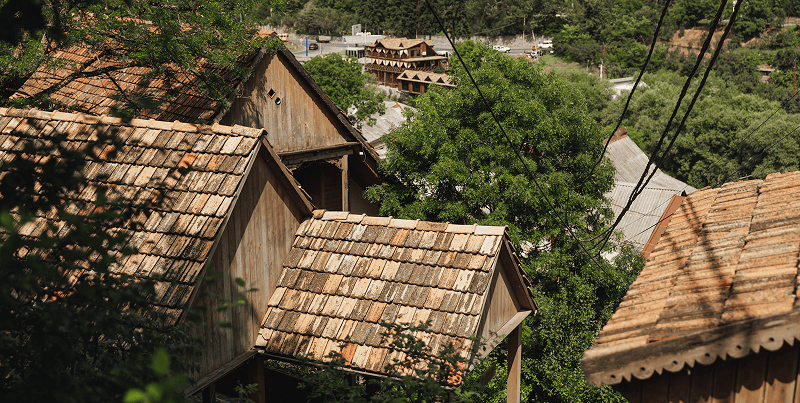
The Dilijan you know today with wooden verandas, coffee shops didn’t start under Soviet rule, or even the Russian Empire. This is the story of how the land above the Aghstev River went from a Kura-Araxes settlement to a royal getaway for Armenian kings, long before it had its current name.
Part 1: Ancient Times and Great Armenia
People Were Making Pottery in Dilijan Thousands of Years Before Armenia Existed
Archaeologists trace the earliest signs of life in this area back to the Kura-Araxes culture, around the third millennium BC. People here already farmed with simple wooden plows, raised livestock, and made tools out of metal — sickles, axes, spearheads — though stone tools were still part of everyday life. Pottery was a real point of pride: by hand, they shaped thousands of vessels and jugs, each one carved or pressed with geometric patterns.
A King’s Signature in Stone
Artashes I, 2nd Century BC
On the road from Dilijan toward Ijevan, near the village of Tekhut, two stones with Aramaic inscriptions were found. King Artashes I placed them there — the same king who declared Great Armenia an independent state in 189 BC. The stones marked the edges of his kingdom: a rare case where a 2,000-year-old border survives not in some old chronicle, but as a real, physical object.
Not Just a Province, but a Royal Getaway
The Arshakuni Dynasty and Hovk, 1st Century AD
The area became part of Great Armenia as the Varazhnunik district of the Ayrarat province, and for a long time it stayed just that — a province. Everything changed when the Arshakuni dynasty took power: the lands along the Aghstev River, including Dilijan itself — then known as Hovk — became a royal residence and hunting ground.
The World’s First Christian State
301 AD
Under Trdat III, also from the Arshakuni line, Armenia officially made Christianity its state religion. For Dilijan — where the monasteries of Goshavank and Haghartsin would later rise — this marked the start of an entirely different culture.
But centuries later, a unified Armenia ceased to exist: by the end of the 4th century, the country was split between Byzantium and Persia. What happened to Dilijan next — that’s the next part of the story.