

A woman walks through a dark forest, calling for her missing son.
“Dili, jan! Dili, jan!”
Her voice disappears among the trees, but the words remain. According to Dilijan’s best-known legend, this desperate call eventually became the name of the town.
It is a beautiful explanation – perhaps too beautiful. The story has everything a good legend needs: forbidden love, loss, a grieving mother and the deep forests of Dilijan. It also has one serious problem: no early document tells it.
The true origin of the name “Dilijan” is still uncertain. What survives is a mixture of folklore, historical records, personal names and later theories. Some parts can be documented. Others belong entirely to the world of storytelling.
The legend of the shepherd Dili
The most popular version begins with a young shepherd named Dili. He falls in love with the daughter of a wealthy lord, forgetting (or choosing to ignore) the difference in social status between them.
When the girl’s father discovers the relationship, he decides to get rid of the shepherd. In some versions, Dili is taken into the forest and killed. In others, he is deliberately abandoned among the mountains, where no one will be able to find him. Dili’s mother searches for her only son for days, walking through the forest and crying: “Dili, jan! Dili, jan!”
In Armenian speech, “jan” is a common warm term of affection added after a person’s name. Depending on the context, it can be understood as “dear” or “beloved”. It is still commonly used when speaking to family members, friends and people one feels close to.
The phrase therefore sounds completely natural. A mother calling “Dili, jan” is emotionally and linguistically believable. According to the legend, her repeated cry echoed through the valley for so long that the surrounding place became known as Dilijan.
A story that changes with every teller
There is no single fixed version of the legend. The central figure may be a shepherd or simply a local young man. Sometimes it is his mother who searches for him, in other retellings, it is his father or other relatives. One story blames the powerful father of Dili’s beloved, while another says that Dili became lost and was killed by wolves.
The details change, but the emotional structure remains the same: someone named Dili disappears, and someone who loves him continues to call his name. The changing versions do not make the legend meaningless. They simply show that it is folklore rather than a verified historical account.
What the written record actually says
The documents are far less romantic.
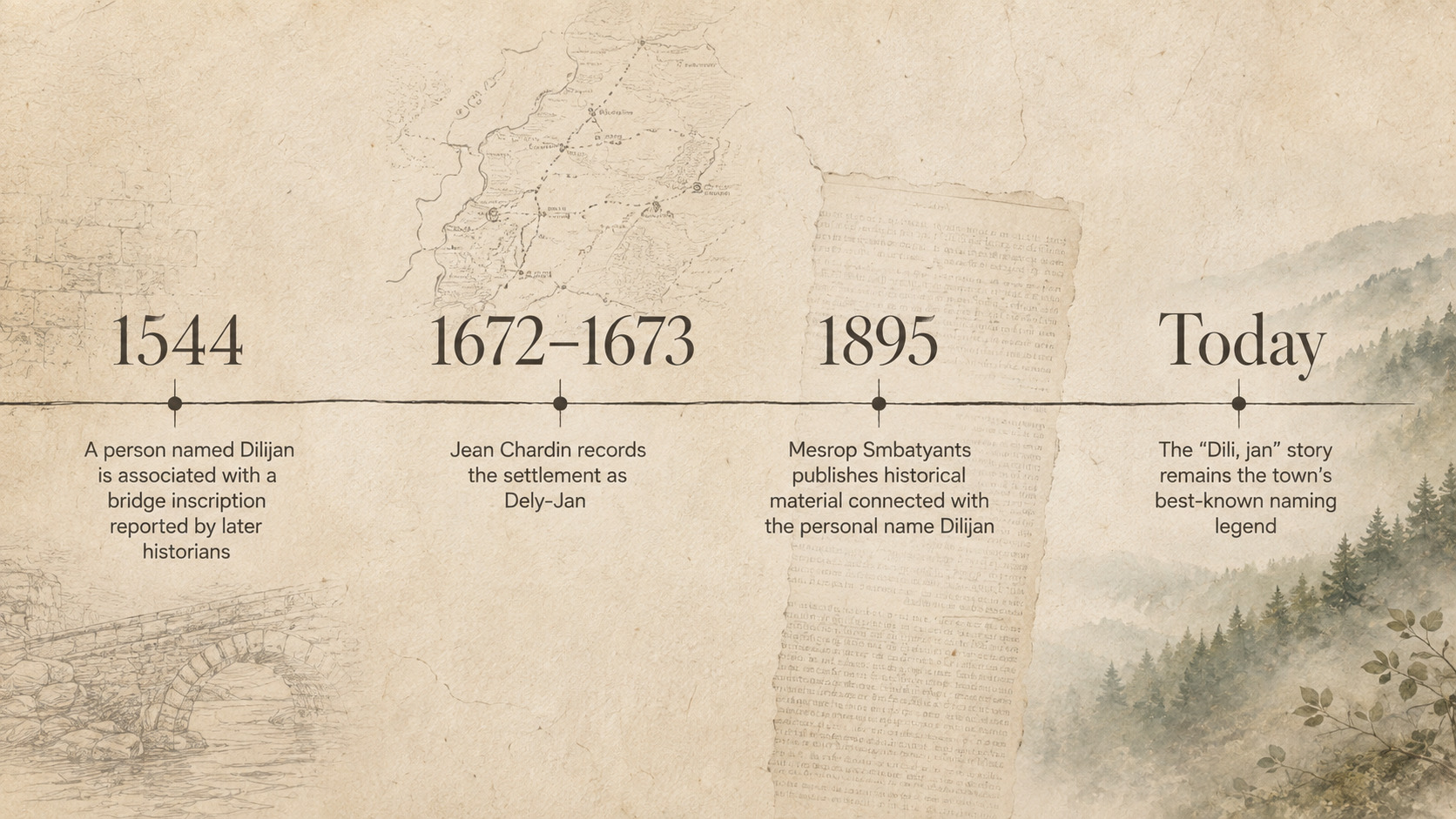
One of the earliest clearly verifiable written forms of the town’s name appears in the travel account of the French traveller Jean Chardin. During his journey through the Caucasus towards Persia in 1672-1673, Chardin passed through a settlement that he recorded as “Dely-Jan”. He described it as a village of approximately 300 houses, situated beside the river that is now known as the Aghstev. The description suggests that it was already a substantial settlement rather than a recently named stopping point.
Chardin’s account is important because it confirms that a recognisable form of the name was in use by the seventeenth century. But it does not explain where the name came from.
A sixteenth-century clue: was Dilijan originally a person’s name?
Another theory connects the town not with a spoken phrase, but with a real personal name. In an 1895 historical and geographical study, Armenian historian Mesrop Smbatyants reported information about a man named “Melik Dilijan”, described as the grandson of Hovhannes and the son of Ter-Matevos. According to the text cited by later historians, he moved from Gavar to Ghshlagh with his family and built a bridge there in 1544.
A village could have been named after a landowner, local leader, founder or influential family. Such a development would not be unusual. However, there is no surviving document that directly says: “This settlement was named after this man.” The personal-name theory is therefore more historically grounded than the romantic legend, but it is still a theory rather than a final answer.
Was there once a place called “Little Dili”?
Modern histories of Dilijan often refer to a medieval settlement called Puchur Dili, or ‘Little Dili’, and attribute the name to Kirakos Gandzaketsi. If this identification is correct, it could mean that a name related to Dili was already attached to the area during the Middle Ages – long before Chardin’s visit and before the sixteenth-century personal name recorded by Smbatyants.
The difficulty is that the exact passage is not consistently provided in popular retellings, making the claim hard to verify from readily accessible editions of Gandzaketsi’s work. It is better treated as an interesting historical possibility, not as an established first mention of Dilijan.
The same caution applies to attempts to identify modern Dilijan directly with historical “Hovk”, an area associated with royal summer residences and hunting grounds. The wider territory may have formed part of historical Hovk, but there is no clear evidence that the present town itself once carried that name.
Stagecoaches, sweet speech and other popular explanations
Another popular story links Dilijan with the French word “diligence”, meaning a stagecoach. Some local retellings connect it with European missionaries travelling through the Aghstev Valley in the seventeenth century. No documentary evidence shows that they named (or renamed) the settlement, however, so the resemblance is best treated as folk etymology rather than historical explanation.
Another popular interpretation claims that “Dili jan” means something like “sweet tongue” and refers to the pleasant speech or dialect of local residents. This explanation is closer to wordplay than academic etymology. It may express local pride, but it does not establish the historical origin of the name.
These theories are examples of folk etymology: people hear familiar words inside an old or unclear name and create a story that explains them.
So where did the name Dilijan come from?
The exact answer remains unknown.
By the seventeenth century, a recognisable form of the name was already being used for a large settlement. Historical references also suggest that Dilijan may previously have existed as a personal or family name. An even earlier connection with a medieval “Little Dili” is possible, although it requires stronger primary-source confirmation.
The most famous “Dili, jan” story belongs to folklore. There is no historical evidence that a grieving mother’s call literally created the town’s name.
But that does not mean historians have destroyed the legend. They have simply placed it where it belongs: not in the town’s official birth certificate, but in its cultural memory. The documents preserve the name. The legend gives it a voice.