English Հայերեն Русский

Before the menu: what people used to eat in Dilijan

Before the menu: what people used to eat in Dilijan

Ask what to eat in Dilijan today and the answers arrive quickly: khash, khorovats, gata, tolma. All are worth trying. None, however, tells the whole story of how people here actually ate.

The older food memory of Dilijan is less photogenic. It lives in braids of dried wild sorrel, jars of pickled mushrooms, beans stored for winter and fermented milk made to last long after the cows had left their summer pastures. It tastes of nettles in spring, mushrooms after rain, rosehips in autumn and grains when almost nothing fresh is growing.

This makes sense once you look outside the kitchen. Dilijan developed inside one of Armenia’s richest forest landscapes. The Ministry of Environment lists 902 species of plants in Dilijan National Park, while Armenia’s official tourism portal describes Tavush as a region particularly rich in wild edible herbs, berries and mushrooms. In other words, the forest was never just scenery. It was part of the pantry.

And that is probably the best way to understand traditional Dilijan food: not as a list of recipes, but as a system built around seasons, preservation and family knowledge.

Spring began with what appeared on the ground

After a mountain winter, the first exciting ingredient was not meat. It was green.

Local culinary records describe nettle soup as one of Dilijan’s characteristic spring dishes, cooked with potatoes, egg and butter. Mallow also went into soups and stews. Sindrik – Solomon’s seal (a wild plant with asparagus-like young shoots) was boiled and eaten simply, often with salt or matsun. Then there was aveluk, the wild sorrel that appears across Eastern Armenian cooking.

The striking thing about these plants is that they blur the modern distinction between “ingredient” and “something growing by the path”. Ethnobotanical research in Armenia has documented a remarkably large repertoire of wild foods, while the Smithsonian magazine has described the harvesting of edible greens as a practice passed through generations.

Aveluk is a perfect example. Fresh leaves are only the beginning. Traditionally they are dried and braided, which changes their taste and allows them to be stored. In Dilijan they have been used for soups, salads and fried dishes: one local version, prtuk, thickens an aveluk soup with flour or small pieces of dough.

So spring did not simply produce spring food. It produced part of winter’s food too.

The forest had its own mushroom season

If one ingredient deserves to be called distinctly Dilijani, mushrooms have a strong case.

They are far less central to the stereotypical image of Armenian cuisine than lavash, grilled meat or cheese, yet the humid forests around Dilijan are exceptionally suited to them. The Smithsonian’s reporting on Armenian foraging specifically points travellers towards the mushroom-rich forests around Goshavank, while Armenia’s tourism authority singles out mushroom diversity as one of Tavush’s culinary characteristics.

Traditionally, mushrooms were not treated as a gourmet curiosity. They were simply seasonal food. What could not be eaten immediately could be salted or marinated for later.

That knowledge mattered. Knowing which mushroom to pick was part of knowing the landscape, much like knowing where the best berries or herbs appeared. Today, of course, amateur foraging is another matter: the Armenian 1000 Leaf project explicitly warns against eating anything that has not been positively identified. The culinary tradition is worth exploring, guessing your way through wild fungi is not.

Summer was partly about preparing for winter

A summer kitchen in Dilijan had two jobs: eat what was fresh and make sure some of it survived.

The forests around the town contain wild fruit and nut species including walnut, cornelian cherry, plum, pear, hazelnut and hawthorn. Fruit became preserves, herbs were dried for cooking and tea, mushrooms were pickled, rosehips harvested later in the year could become tea, jam, juice or the local preparation known as masramatsun.

Even green beans could move from summer vegetable to winter ingredient. Local Dilijan culinary documentation records a dried form known locally as khasham lobí: the beans were stored, then soaked before being cooked in cold-season soups.

Milk had a winter plan too

Perhaps the cleverest transformation happened with dairy.

Matsun is still so ordinary in Armenia that it is easy to overlook how useful fermentation was before refrigeration. But Dilijan’s pastoral traditions went one step further with choratan: matsun concentrated and dried so that it could be stored for long periods, then reconstituted when needed.

Food-science research describes choratan as precisely that – a long-keeping dried form of matsun that can later become a creamy base again.

Local Dilijan accounts add the human geography. Pastoral families would spend the summer higher in the mountains with their livestock and process the season’s milk into products that could survive the colder months. Choratan could later become a soup, tan with mint or part of khankyal, served with fried onions.

And here the idea of a single “authentic recipe” starts to fall apart. Local documentation explicitly notes that families had their own ways of using choratan. That is how domestic cuisines usually work: the name of the dish may be shared, but the important details belong to a household.

Winter food was deliberately unglamorous

Once the fresh season ended, Dilijan cooking became heavier, slower and more dependent on the pantry.

Beans, wheat and corn mattered. So did the things prepared months earlier: dried aveluk, dried beans, pickled mushrooms, preserves and choratan.

One Tavush cold-season dish is korkot, a substantial combination of wheat and pork. Another local preparation, tsandil or khatkhash, combines corn, wheat and beans. Bean soups paired pulses with grains such as dzavar. These are not the dishes most likely to dominate a restaurant Instagram feed, but that is precisely the point. They were designed around satiety, storage and what a household actually had.

The menu was a calendar.

The villages around Dilijan added their own flavours

Dilijan’s food memory was never sealed inside the town limits.

Follow the road towards Vanadzor and you reach Fioletovo, in neighbouring Lori province, the largest Molokan village in Armenia. The Russian Christian community has lived in the area since the 19th century, and its food traditions developed beside those of Armenian communities in and around the Dilijan basin.

Sauerkraut became such a characteristic product of Fioletovo that journalist Mark Grigoryan described fields of cabbage and the finished fermented cabbage as a calling card of the village. His documentation of Molokan family life also records homemade noodles – rolled thin, briefly dried over heat and later cooked in chicken or beef broth – as an essential wedding food. Today homemade jams and blini remain part of the village table.

Another layer arrived through migration. Dilijan culinary records associate the use of dzavar in one local bean soup with Armenians from the Middle East who settled in the town in the 1940s. This belongs to a much larger historical movement: during the mass repatriations of 1946-1948, tens of thousands of diaspora Armenians came to Soviet Armenia, many from Syria and Lebanon. People moved, and recipes moved with them.

Family recipes were less about measurements than memory

This may be the hardest part of Dilijan cuisine to put on a restaurant menu.

Traditional food knowledge often did not live in cookbooks. It lived in repetition: which greens to pick, how long to dry them, when the milk was right, how sour the pickle should become, whether a soup needed another handful of grain.

That makes “family recipe” slightly misleading. Often what was inherited was not a fixed formula but a method, and the confidence to adjust it without measuring anything.

Two neighbouring houses could therefore make the “same” food and still insist that the other house was doing it slightly wrong. Some culinary traditions are universal after all.

Restaurant Dilijan and home Dilijan are not quite the same place

None of this means that restaurant food is somehow fake.

Restaurants have a different job. A visitor arriving for one evening wants a meal, not six months of agricultural context. Familiar Armenian dishes travel well onto menus, a jar prepared in September for a family kitchen does not.

Even wild mushrooms, now quite visible in Dilijan restaurants, tend to appear in restaurant-friendly forms: with eggs, in soups, with potatoes, pasta or arishta. The domestic food system behind them is much harder to serve on a plate.

This gap exists elsewhere in Armenia too. Smithsonian researchers have noted that some traditional dishes built around wild greens remain far easier to find in private kitchens than in tourist restaurants. Local people do not need to order them: they already know someone who makes them.

And perhaps this is the useful distinction. Restaurant cuisine asks, “What should we cook for a guest today?” Traditional home cooking asked a different question: “What is available now, and how can we make it last?”

Dilijan’s gastronomic memory was never just a menu.

It was a way of living with the landscape.
The forest has good acoustics: how Dilijan became Armenia’s creative retreat

Long before coworking spaces, artist residencies and creative-tech labs appeared in Dilijan, poets, composers, painters and filmmakers were already coming here to work. The tools have changed. The reason to come has not.

In June 1908, the composer Komitas wrote to poet Hovhannes Tumanyan about a problem familiar to anyone who has ever tried to finish a creative project: they needed to get away somewhere and finally do the work.

Komitas suggested Dilijan.

The plan was practical rather than romantic. They could spend around ten days there working on the libretto of Anush, Tumanyan’s poem that Komitas hoped to turn into an opera. There was no talk of “creative energy” or finding inspiration. They simply needed time, concentration and a place to work together.

More than a century later, this still feels like one of the best explanations for Dilijan’s relationship with creative people. Artists did not keep coming here only because the town was beautiful. Armenia has no shortage of dramatic mountains. What Dilijan repeatedly offered was something more useful – distance without isolation. Quiet enough to disappear into your work, connected enough to meet other people doing interesting things.

Private summer houses became Soviet creativity resorts. Composers were followed by filmmakers. Industrial buildings became art laboratories. Today the same town has TUMO students making animated films, artists creating installations, engineers prototyping at a Fab Lab and remote workers opening laptops within walking distance of the forest.

Dilijan did not become a creative city overnight. It has been rehearsing the role for more than a hundred years.

Before creative residencies had a name

The first version of creative Dilijan looked less like an institution and more like a summer house with an unusually good guest list.

By the late 19th and early 20th centuries, Dilijan had developed a reputation as a mountain resort. Wealthy families from Tbilisi built summer homes here, among them was philanthropist and cultural activist Princess Mariam Tumanyan. Her house became a meeting place for Armenian intellectuals and artists, associated with figures including Hovhannes Tumanyan, Alexander Shirvanzade, Avetik Isahakyan and Armen Tigranyan.

This matters because Dilijan’s artistic reputation did not begin with Soviet cultural policy. The pattern was already there: leave the city for summer, move into the forest, and discover that half the people you wanted to talk to had apparently had the same idea.

Komitas’s 1908 letter fits neatly into this world. Dilijan was somewhere work could happen precisely because life slowed down without becoming intellectually empty.

Mariam Tumanyan’s house later had an appropriate second life. Painter and cultural figure Hovhannes Sharambeyan lived there and helped transform it into Dilijan’s folk art museum in 1979. Following restoration, the building reopened in 2026 as the Armenian Textile Museum, combining historical collections with workshops, music, festivals and contemporary craft.

A former summer salon becoming an active cultural centre more than a century later is almost too perfect a metaphor for the town.

Then the Soviet Union made the retreat official

If pre-Soviet Dilijan developed its cultural reputation organically, the USSR put infrastructure around it. Across the Soviet Union, Creativity Houses were established for writers, architects, artists, composers and filmmakers. They were part workplace, part sanatorium, part professional club: places where members of creative unions could live for weeks, work individually and meet colleagues away from city life.

Dilijan proved particularly suited to the model. In 1963, the House of Composers’ Creativity opened in the wooded hills outside town, largely through the efforts of Armenian composer Edward Mirzoyan. It began with a small collection of cottages and later expanded to include a library, cinema, restaurant, sports facilities and the Beethoven concert hall.

Even its architecture explains what the place was for. The cottages were separated so that one composer’s piano or rehearsals would not destroy another’s concentration. The idea was simple: give people privacy when they need it and company when they don’t. It worked remarkably well.

The guest list became slightly absurd

At some point, reading the names associated with Dilijan’s Composers’ House starts to feel like opening several cultural encyclopedias at once.

Dmitri Shostakovich came here. So did Benjamin Britten, Mstislav Rostropovich and Galina Vishnevskaya. Armenian composers including Aram Khachaturian and Arno Babajanyan were closely associated with the resort. Rodion Shchedrin, Giya Kancheli, painter Martiros Saryan and ballerina Maya Plisetskaya also appeared in its orbit.

The anecdotes make the place feel considerably less solemn than the guest list suggests. Local histories remember composers playing football, Plisetskaya collecting mushrooms and Saryan sitting among the apple trees. One story has Shostakovich refereeing a football match and protesting whenever a badly aimed ball knocked apples from the trees.

Which is a useful context. Dilijan was not a remote monastery where Great Men sat alone and produced masterpieces on command. It was social. And sometimes the work followed.

Shostakovich’s stays associated in local histories with work on his Ninth String Quartet and music for Grigori Kozintsev’s “Hamlet”. Benjamin Britten’s 1965 visit is more firmly documented: while staying in Dilijan with Peter Pears, Rostropovich and Vishnevskaya, he composed his Pushkin song cycle “The Poet’s Echo”. Armenian musical sounds encountered during the trip found their way into the piece.

Dilijan was not simply hosting cultural celebrities after their important work was finished elsewhere. Some of the work was being made here. And the tradition has not entirely disappeared. Beethoven Hall continues to host concerts and contemporary music programmes, including new generations of Armenian composers.

It was never only about composers

The name “House of Composers” makes Dilijan’s cultural life sound more neatly divided by profession than it really was.

Painters, writers, musicians and performers moved through the same social world. Martiros Saryan’s connection to the Composers’ House is one example. Hovhannes Sharambeyan’s life in Dilijan is another. Writers including Tumanyan and Yeghishe Charents also belonged to the broader intellectual history of the town.

This cross-pollination may explain more about Dilijan than any list of famous visitors. Creative communities become interesting when categories get messy. A composer meets a painter. A writer shares dinner with a musician. Someone comes to rest, stays for three weeks and begins a project they had not planned to make.

The town became valuable not simply because famous artists visited it, but because they kept encountering one another here.

Cinema got its own house

By the late Soviet period, music no longer had the retreat business to itself.

A separate Cinematographers’ Creativity House was developed in Dilijan in the late 1970s and early 1980s. It belonged to the same Soviet system: purpose-built environments where cultural professionals could work and spend extended periods outside their everyday routines.

By then, Dilijan’s reputation as a workplace for the cultural intelligentsia had literally become architectural. Cinema also gave the town one of its most persistent pieces of popular mythology.

The 1977 Soviet comedy “Mimino” made Rubik Khachikyan, played by Frunzik Mkrtchyan, a proud son of Dilijan, and turned his boast about the local water into a line generations of viewers still associate with the town. The film was not actually a Dilijan movie, the connection comes through its character. But in 2011, Dilijan made that fictional relationship physical by installing a monument to Rubik, Valiko and Volokhov in the city centre.

Today screen culture has taken another form. Dilijan-based Ditaran works with immersive media, 360-degree fulldome films, projection mapping and exhibitions. It is a technological leap from the Soviet filmmakers’ retreat, but the basic premise – making visual culture in a small mountain town – remains familiar.

After the USSR, the idea escaped from the cottages

The collapse of the Soviet Union badly affected creativity houses across the region. Funding disappeared, buildings deteriorated and Dilijan’s cultural ecosystem inevitably changed. But the more interesting story is how the format of creativity changed with it.

In 2016, the Dilijan Arts Observatory brought artists, designers, musicians, cultural historians and environmental researchers to town for several weeks of interdisciplinary work. Instead of placing everyone in idyllic cottages, organisers made the former Soviet Impuls electronics factory their headquarters.

Participants explored local craft, music, architecture, food, botany and Soviet heritage. Dilijan itself became the subject: not a picturesque background, but something to study, question and work with.

There is a satisfying symmetry here. During the Soviet era, the state created special places where cultural workers could escape ordinary production. Decades later, artists entered an abandoned space of Soviet production – a factory – and turned it into a cultural laboratory.

Dilijan had moved from retreat to research site.

The residency moved into the neighbourhood

That idea continues to evolve. In 2025, Dilijan Space and UWC Dilijan developed the “Common Senses” artist residency around a different question: what happens if visiting artists work not simply in Dilijan, but with its neighbourhoods and residents?

Artists researched local histories, met inhabitants and developed public works responding to different parts of town. Dilijan Space reflects the same approach. Its exhibitions combine historical artefacts, photographs, architecture and multimedia with projects about the city’s possible futures. It treats Dilijan less as a finished heritage object and more as an ongoing experiment.

That is an important shift from the classic artist colony. You no longer need to leave the city behind to become creative. The city – its buildings, memories, abandoned factories and changing neighbourhoods – can itself become the material.

The composers now have neighbours with laptops

The most visible change is that Dilijan’s creative vocabulary has expanded beyond the traditional arts.

TUMO opened its Dilijan centre in 2013, bringing teenagers into creative technology through animation, filmmaking, music, design and other digital disciplines.

A few years later, Fab Lab Dilijan added digital fabrication, 3D printing and prototyping, connecting artists with engineers, educators, scientists and developers. Its ambition is straightforward: to help turn Dilijan into a “maker city”.

The same logic is appearing in more everyday forms. Coworking spaces such as Toon Armeni sell the possibility of working remotely while living next to the forest. New cultural developments propose artist studios, residency spaces and outdoor work areas.

A century ago, someone arriving in Dilijan with unfinished work might have carried sheet music or a manuscript. Now it could just as easily be a laptop.

So why Dilijan?

It is tempting to give the forest all the credit. The landscape clearly matters. Dilijan had already become a resort before its major cultural institutions appeared: wooded mountains, cooler summers and enough distance from urban routine to make ordinary time feel slightly suspended.

But beautiful scenery alone does not create a creative town. Infrastructure does.

Mariam Tumanyan offered a house and a social circle. The Soviet system offered cottages and concert halls. The Arts Observatory offered an abandoned factory and an international network. TUMO offers technology and mentors. Fab Lab offers tools. Residencies offer time. Coworkings offer desks – and other people avoiding their desks.

The technology changes, but the formula remains remarkably stable: give people enough distance to think. Give them somewhere to work. Then make sure interesting people keep bumping into one another.

That may be Dilijan’s most durable cultural inheritance. The town was never simply a beautiful place that happened to attract artists. For more than a century, it has repeatedly built reasons for them to stay.

Why is Dilijan called Dilijan? A legend, a traveller and a name with no certain origin

A woman walks through a dark forest, calling for her missing son.

“Dili, jan! Dili, jan!”

Her voice disappears among the trees, but the words remain. According to Dilijan’s best-known legend, this desperate call eventually became the name of the town.

It is a beautiful explanation – perhaps too beautiful. The story has everything a good legend needs: forbidden love, loss, a grieving mother and the deep forests of Dilijan. It also has one serious problem: no early document tells it.

The true origin of the name “Dilijan” is still uncertain. What survives is a mixture of folklore, historical records, personal names and later theories. Some parts can be documented. Others belong entirely to the world of storytelling.

The legend of the shepherd Dili

The most popular version begins with a young shepherd named Dili. He falls in love with the daughter of a wealthy lord, forgetting (or choosing to ignore) the difference in social status between them.

When the girl’s father discovers the relationship, he decides to get rid of the shepherd. In some versions, Dili is taken into the forest and killed. In others, he is deliberately abandoned among the mountains, where no one will be able to find him. Dili’s mother searches for her only son for days, walking through the forest and crying: “Dili, jan! Dili, jan!”

In Armenian speech, “jan” is a common warm term of affection added after a person’s name. Depending on the context, it can be understood as “dear” or “beloved”. It is still commonly used when speaking to family members, friends and people one feels close to.

The phrase therefore sounds completely natural. A mother calling “Dili, jan” is emotionally and linguistically believable. According to the legend, her repeated cry echoed through the valley for so long that the surrounding place became known as Dilijan.

A story that changes with every teller

There is no single fixed version of the legend. The central figure may be a shepherd or simply a local young man. Sometimes it is his mother who searches for him, in other retellings, it is his father or other relatives. One story blames the powerful father of Dili’s beloved, while another says that Dili became lost and was killed by wolves.

The details change, but the emotional structure remains the same: someone named Dili disappears, and someone who loves him continues to call his name. The changing versions do not make the legend meaningless. They simply show that it is folklore rather than a verified historical account.

What the written record actually says

The documents are far less romantic.

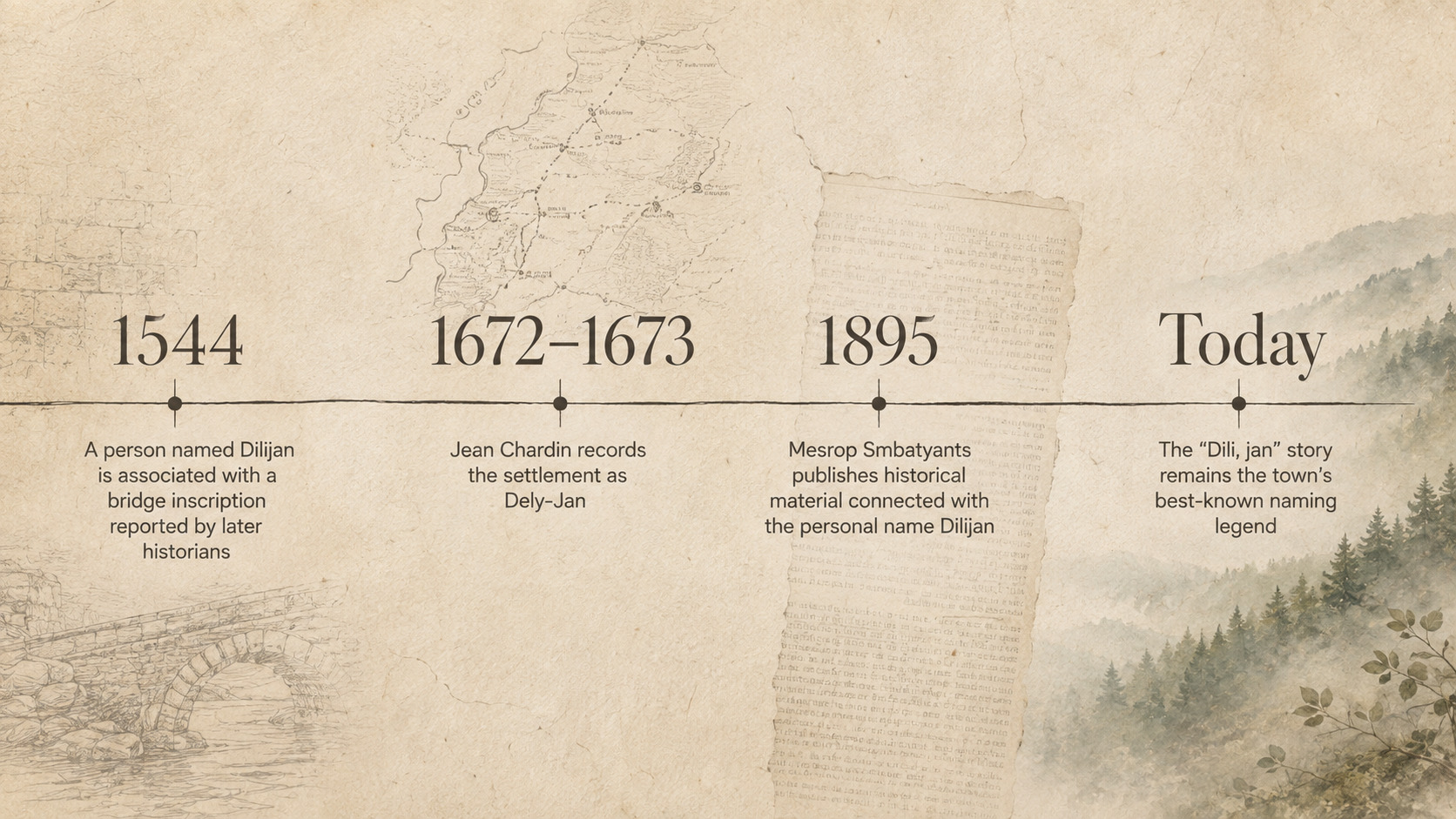
One of the earliest clearly verifiable written forms of the town’s name appears in the travel account of the French traveller Jean Chardin. During his journey through the Caucasus towards Persia in 1672-1673, Chardin passed through a settlement that he recorded as “Dely-Jan”. He described it as a village of approximately 300 houses, situated beside the river that is now known as the Aghstev. The description suggests that it was already a substantial settlement rather than a recently named stopping point.

Chardin’s account is important because it confirms that a recognisable form of the name was in use by the seventeenth century. But it does not explain where the name came from.

A sixteenth-century clue: was Dilijan originally a person’s name?

Another theory connects the town not with a spoken phrase, but with a real personal name. In an 1895 historical and geographical study, Armenian historian Mesrop Smbatyants reported information about a man named “Melik Dilijan”, described as the grandson of Hovhannes and the son of Ter-Matevos. According to the text cited by later historians, he moved from Gavar to Ghshlagh with his family and built a bridge there in 1544.

A village could have been named after a landowner, local leader, founder or influential family. Such a development would not be unusual. However, there is no surviving document that directly says: “This settlement was named after this man.” The personal-name theory is therefore more historically grounded than the romantic legend, but it is still a theory rather than a final answer.

Was there once a place called “Little Dili”?

Modern histories of Dilijan often refer to a medieval settlement called Puchur Dili, or ‘Little Dili’, and attribute the name to Kirakos Gandzaketsi. If this identification is correct, it could mean that a name related to Dili was already attached to the area during the Middle Ages – long before Chardin’s visit and before the sixteenth-century personal name recorded by Smbatyants.

The difficulty is that the exact passage is not consistently provided in popular retellings, making the claim hard to verify from readily accessible editions of Gandzaketsi’s work. It is better treated as an interesting historical possibility, not as an established first mention of Dilijan.

The same caution applies to attempts to identify modern Dilijan directly with historical “Hovk”, an area associated with royal summer residences and hunting grounds. The wider territory may have formed part of historical Hovk, but there is no clear evidence that the present town itself once carried that name.

Stagecoaches, sweet speech and other popular explanations

Another popular story links Dilijan with the French word “diligence”, meaning a stagecoach. Some local retellings connect it with European missionaries travelling through the Aghstev Valley in the seventeenth century. No documentary evidence shows that they named (or renamed) the settlement, however, so the resemblance is best treated as folk etymology rather than historical explanation.

Another popular interpretation claims that “Dili jan” means something like “sweet tongue” and refers to the pleasant speech or dialect of local residents. This explanation is closer to wordplay than academic etymology. It may express local pride, but it does not establish the historical origin of the name.

These theories are examples of folk etymology: people hear familiar words inside an old or unclear name and create a story that explains them.

So where did the name Dilijan come from?

The exact answer remains unknown.

By the seventeenth century, a recognisable form of the name was already being used for a large settlement. Historical references also suggest that Dilijan may previously have existed as a personal or family name. An even earlier connection with a medieval “Little Dili” is possible, although it requires stronger primary-source confirmation.

The most famous “Dili, jan” story belongs to folklore. There is no historical evidence that a grieving mother’s call literally created the town’s name.

But that does not mean historians have destroyed the legend. They have simply placed it where it belongs: not in the town’s official birth certificate, but in its cultural memory. The documents preserve the name. The legend gives it a voice.

5 places to have a picnic in Dilijan

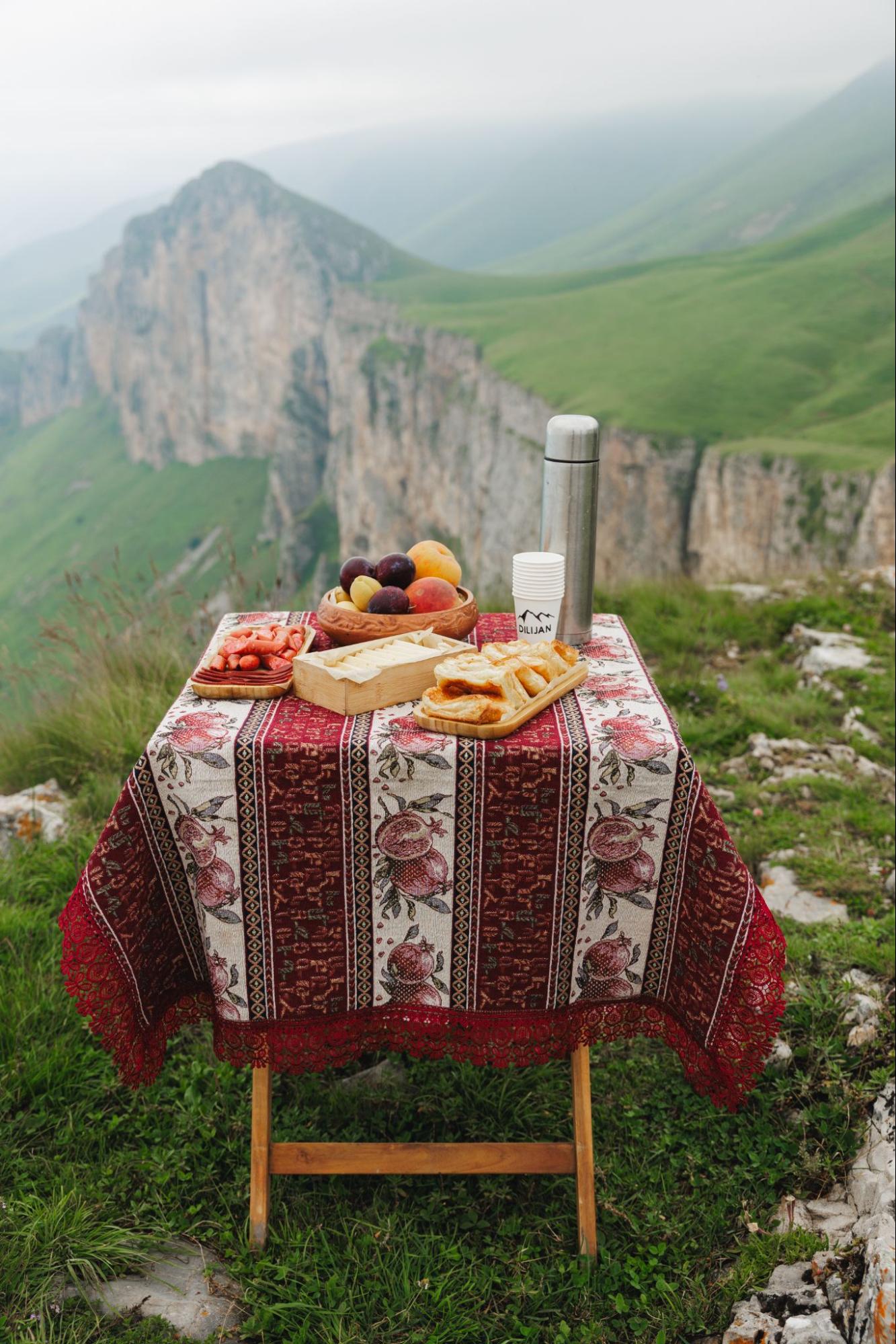
A picnic in Dilijan is rarely just a picnic. It is usually lunch, a forest walk, a slightly overambitious bag of food and someone saying, “Let’s go just a little farther,” before the road turns into a proper hike.

The good news: Dilijan is very forgiving. You can spread a blanket near a lake, find a quiet clearing after a short walk, or build your whole day around khorovats, fresh bread, fruit and the noble Armenian tradition of packing enough food for twelve people when there are only three of you.

Here are a few good options, from easy and social to properly foresty.

1. Lake Parz: the classic choice for a no-stress picnic

Lake Parz is the obvious answer – and for once, obvious is not a bad thing. This small lake in Dilijan National Park is surrounded by forest, has walking paths, places to sit, cafés in season and activities such as boat rental. In other words: it is ideal for people who want nature but would also like access to coffee and a toilet. A revolutionary combination.

2. Gosh Lake: for people willing to earn their lunch

If Lake Parz is the easy-going cousin, Gosh Lake is the friend who says, “It’s not far,” and technically means it – but forgets to mention the uphill part.

The lake lies near Gosh village and is reached by a forest hike. The route is beautiful, green and peaceful, and there are picnic areas near the shore. This is a wonderful choice for a small group that likes walking and does not mind carrying lunch in a backpack rather than arriving beside it by car.

Once you get there, the setting feels more secluded than Lake Parz: water, trees, mountain air and the very satisfying feeling that your cheese sandwich has been morally upgraded by physical effort.

3. The pine grove above town: the easy local escape

You do not always need a lake or a heroic trail. Above Dilijan, there are forest roads, pine groves and simple open spots where a short drive or walk can lead to a very convincing afternoon outdoors.

This is the option for a slow picnic: buy lavash, local cheese, tomatoes, greens, fruit and something from a bakery in town, bring a blanket, then find a legal, established recreation spot rather than stepping deep into the forest at random. The best picnics here are usually the least theatrical ones – no schedule, no playlist battle, just the smell of pine needles and a thermos of coffee.

It also works beautifully for families with children, people travelling with older relatives or anyone whose relationship with hiking is mostly emotional.

4. On the Parz–Gosh trail: picnic with a view, not a crowd

For hikers, the trail between Lake Parz and Gosh village offers a more adventurous picnic format. Parts of the route open onto clearings and viewpoints where you can stop for a packed lunch with forest-covered slopes around you.

This is not a “set up a feast and stay all day” kind of place. Think of it as a walking picnic: bread, nuts, dried fruit, chocolate, sandwiches and a flask of tea. The reward is simple – no restaurant soundtrack, no car doors slamming, just the feeling that Dilijan has briefly become your private green room.

Good to know: download an offline map, start early and take your rubbish back with you. A picnic is charming, a plastic bag caught in a tree is not.

5. A small picnic rulebook for Dilijan

A good Dilijan picnic needs very little: food you actually want to eat, layers for cool weather, drinking water, a rubbish bag and an honest estimate of how far you are ready to walk after lunch.

And one more thing: forests, lakeshores and monastery surroundings are not outdoor restaurants with invisible staff. Leave the place cleaner than you found it, keep music low, do not disturb wildlife and save the dramatic “we must live in nature forever” speech until you are safely back in town with Wi-Fi.

In Dilijan, the main ingredient is already there: a landscape that makes even a modest cheese-and-lavash lunch feel like a scene from a film.

9 ideas where to go with children in Dilijan

Dilijan has space: forest, water, room to run, things to touch and stories that do not need a screen to be interesting. The best family days here are about picking one outdoorsy adventure, adding a warm drink or a pastry, and leaving enough time for the child to investigate a mysterious stick. That is the real Dilijan itinerary.

  1. Dilijan City Park is an easy start for everyone

If you need a low-effort afternoon without leaving town, begin in Dilijan City Park. There is a lake, walking paths, open space, catamarans, a basketball court and the VereV rope park, plus cafés nearby for the moment when everyone suddenly becomes hungry.

It is a good first stop after a long drive or for a day when the adults would also like to sit down occasionally. The park is used by local families, which gives it a much more relaxed feeling than a polished tourist attraction. You can take photos with the Mimino monument, rent a bike through the tourist information centre, or simply let the children burn off the energy they somehow still have after a car journey.

  1. Lake Parz: boats, forest and a very good excuse for a picnic

Lake Parz is the most reliable answer to the question: “Where can we take the children for a few hours without anyone getting bored?” Around 20-25 minutes by car from Dilijan, this small forest lake has boats and catamarans, a rope park, a zipline over the water, playground space and picnic areas. Swimming is not allowed, but boating usually provides enough drama anyway.

For smaller children, the main attraction is simply the lake itself: ducks, reflections, snacks in the forest and the important work of collecting exactly seventeen cones. Older children can add the active options, depending on the season and operator conditions.

  1. The Red Deer Breeding Centre: meet the forest’s VIP residents

On the route towards Lake Parz, make time for the Caucasian red deer breeding centre. This is not a petting zoo with an unfortunate rabbit in a corner. It is part of a conservation programme working to restore red deer to Armenia’s forests, which makes the visit more meaningful than a quick animal photo.

Children can see the deer from the visitor area and hear why some animals live in the centre while others are prepared for life in the wild. It is a quiet stop, but often one that stays in a child’s memory much longer than a loud attraction.

  1. Haghartsin and the Hidden Waterfall: a quest with a pastry at the end

Haghartsin Monastery is beautiful enough for adults and mysterious enough for children: old stone churches, forest all around, carved crosses and the pleasing feeling that a medieval story could begin at any moment.

Families with children who are comfortable walking can continue to the Hidden Waterfall trail. The route is 1.6 km one way from the monastery, but the last section includes rocks and stepping stones, so it is not a pushchair route and is best avoided after heavy rain. For young explorers, though, it feels like a proper mission rather than another cultural stop.

  1. Pottery at Dilijan Eco Station

Instead of buying another magnet that will spend the rest of its life on a fridge, let children make something of their own. Fatato Pottery runs clay workshops at Dilijan Eco Station, where young visitors can shape, press, roll and decorate a small piece by hand. The session lasts around an hour and a half – long enough to feel properly creative, but not so long that anyone begins negotiating for snacks. The finished work is fired afterwards, so it becomes a real keepsake from the trip rather than just a rainy-day distraction.

Practical note: book in advance and check the current schedule, age guidance and collection or delivery options for the finished piece.

  1. Old Dilijan: find the people who still make things by hand

Sharambeyan Street, known as Old Dilijan, works particularly well on a rainy day or when everyone needs a slower pace. Yes, it is photogenic. But more importantly, it is a place to show children that bowls, carved letters and jewellery do not appear by magic in souvenir shops.

Look into the working studios, watch craftspeople at their benches and let your child choose one small object with a story behind it. The woodcarving and pottery workshops are especially good for a short, curious visit.

  1. The Dilijan Museum: a rainy-day time machine

The Dilijan Museum of Regional Studies and Art Gallery is not huge, and that is exactly its strength for families. You can spend an hour here rather than attempting a three-hour cultural marathon that ends in mutiny.

Its archaeology, local-history and art collections give children plenty of things to spot: coins, old objects, unusual tools, paintings and evidence that people in Dilijan were living interesting lives long before nowadays. Turn it into a game: each person chooses one object they would take home if the museum somehow offered a very strange “one item free” day.

  1. Yell Extreme Park: for children who hear “zipline” and become instantly alert

For older children and teenagers, Yell Extreme Park in Yenokavan is worth a separate outing. It is outside Dilijan, so treat it as a half-day or full-day adventure rather than a quick stop between lunch and dinner. The park offers zipline flights, off-road trips, horseback riding and other active options in the Tavush mountains.

This is the choice for families whose idea of a good holiday includes a little adrenaline and a child saying, “Can we do that again?” before the harness is fully removed.

  1. A pool day at Dilijan Inn: for children who spot water before they spot mountains

Some children see Dilijan’s forests and think, “Lovely.” Others see a swimming pool and suddenly develop the energy of an Olympic finalist. For them, Dilijan Inn offers a heated outdoor pool with views over the gorge – a very civilised break between hikes, monasteries and the fifth family discussion about whether anyone really needs another pastry. Non-residents can book a day visit in advance, so it can work as a stand-alone activity rather than an excuse to change hotels.

Practical note: the pool is 1.5 metres deep, so children who are not confident swimmers will need close adult supervision. Reserve ahead and confirm the current day-package price, availability and any age rules before going.

Dilijan works best with children when you do not try to turn it into a race. Let the day have one main adventure, one excellent pastry and enough unplanned time for puddles, pinecones and spontaneous questions about medieval monks. The forest will do the rest.

Where to drink wine in Dilijan: a small town guide to a very good evening

Dilijan is known for forests, monasteries and people telling you that the water is excellent. All true. But after a day of hiking, driving up winding roads or politely pretending that you can identify every mountain peak, water may no longer feel like the most exciting option.

This is when Dilijan becomes unexpectedly good at wine.

The Kliver wine place: for a proper wine evening

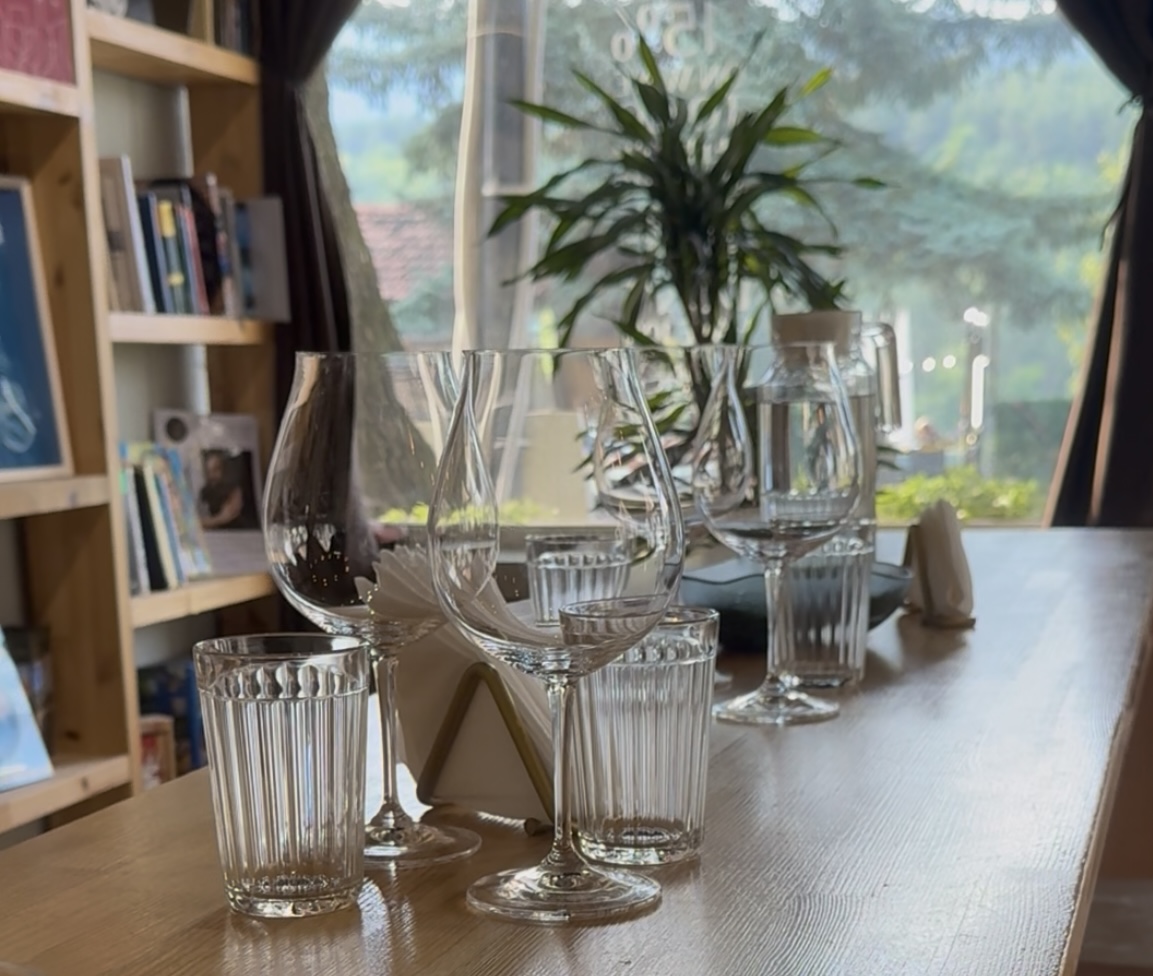
If your ideal night includes a glass of Armenian wine, a cheese plate to share and the possibility of staying longer than planned, start at The Kliver wine place.

Kliver feels less like a place where you simply “go for dinner” and more like a place where the evening gathers itself. You might arrive after a walk, take a seat for one glass, then discover that someone has opened another bottle, suddenly a live concert starts, and in one moment you understand that it is much later than you thought.

The focus is, naturally, wine: glass positions, foreign bottles and a special offer of express tasting where you will not only enjoy good Armenian wine, but also hear the history of it. Kliver also works well for people who do not want a formal tasting. Come after hiking, order a glass of red with a cheese plate, and let the evening do its job.

Hovaz Wine Rooms

Hovaz Wine Rooms is the place to choose when one glass feels a little too casual and you want to understand what is actually happening in it.

This is closer to a small tasting room than a standard bar: a place for trying wines slowly, comparing bottles and pairing them with good bread or small snacks. The point is not to perform expertise.

For visitors, Hovaz is a useful introduction to Armenian wine beyond the familiar supermarket labels. Ask about the producer, the grape, the region and whether there is something less obvious to try. A tasting here works especially well for couples, small groups and anyone who wants an evening plan with a little story behind it.

Dilijani Tun: a tasting that goes beyond the town

Dilijani Tun offers another route into Armenian wine: not just a bottle with dinner, but a more structured tasting experience. Its wine programme includes selections from Armenian producers, including wines connected with nearby Tavush and the wider Armenian wine map, alongside brandy tastings.

It is a good option for travellers who want an introduction without organising a full winery trip. You can try several wines in one sitting, learn a little about local styles and finally settle the important question: are you a crisp white person, a serious red person, or a person who came for wine and left emotionally attached to pomegranate wine?

Café #2: wine with a little city energy

It is more café-bar than solemn wine temple, which is probably for the best. Dilijan does not need anyone swirling a glass dramatically while explaining “notes of wet stone.” The town already has enough actual wet stone.

The menu gives you room to build the evening your own way: food first, wine second, a proper meal with friends or a casual stop before moving somewhere else. It is a useful place to remember when the group cannot agree on anything, which is most groups after 8 PM.

A good restaurant table: do not underestimate the simple option

Not every good glass of wine in Dilijan needs to come with a wine-bar label. Some of the nicest evenings happen at a restaurant table: warm food, local vegetables, grilled meat or fish, a bottle of Armenian red, and the comforting realization that nobody is in a hurry to replace your table with new guests.

When choosing wine with dinner, do not automatically order the safest international grape on the list. Armenia’s local varieties are worth a try. Areni is the obvious red starting point: usually fruity, earthy and easy to drink with food. For white wine, ask what Armenian bottles are available and whether the staff has a favourite. You may get a better answer than “the house white.”

For a slower night: buy a bottle and stay somewhere beautiful

Dilijan is one of the few places where taking a bottle back to your hotel, guesthouse balcony or forest-facing terrace can feel like a very legitimate evening plan.

Buy wine from a local supermarket or in Kliver (by the way, they have a 15% discount for bottles to take away) or ask your host for a recommendation. Add fruit, bread, cheese, something salty, and perhaps one person who knows how to open a bottle without injuring themselves. That is enough.

This option is especially good after a long day outside. The town becomes quiet early, the air cools down, and the forests around Dilijan make even an ordinary bottle feel slightly cinematic.

Dilijan after dark: what to do in the city after sunset

The biggest mistake a visitor can make in Dilijan is deciding that, once the sun goes down, there is nothing left to do.

It is an understandable mistake. Most itineraries treat Dilijan as a daytime destination: wake up, hike through the forest, drive to Haghartsin, stop at Lake Parz, walk along Sharambeyan Street, have dinner and leave. By 9 PM, the travel guide has effectively clocked off too.

But Dilijan does not shut down after dinner. It simply changes tempo. The trick is to know where to go.

For wine, tastings and an unhurried second act

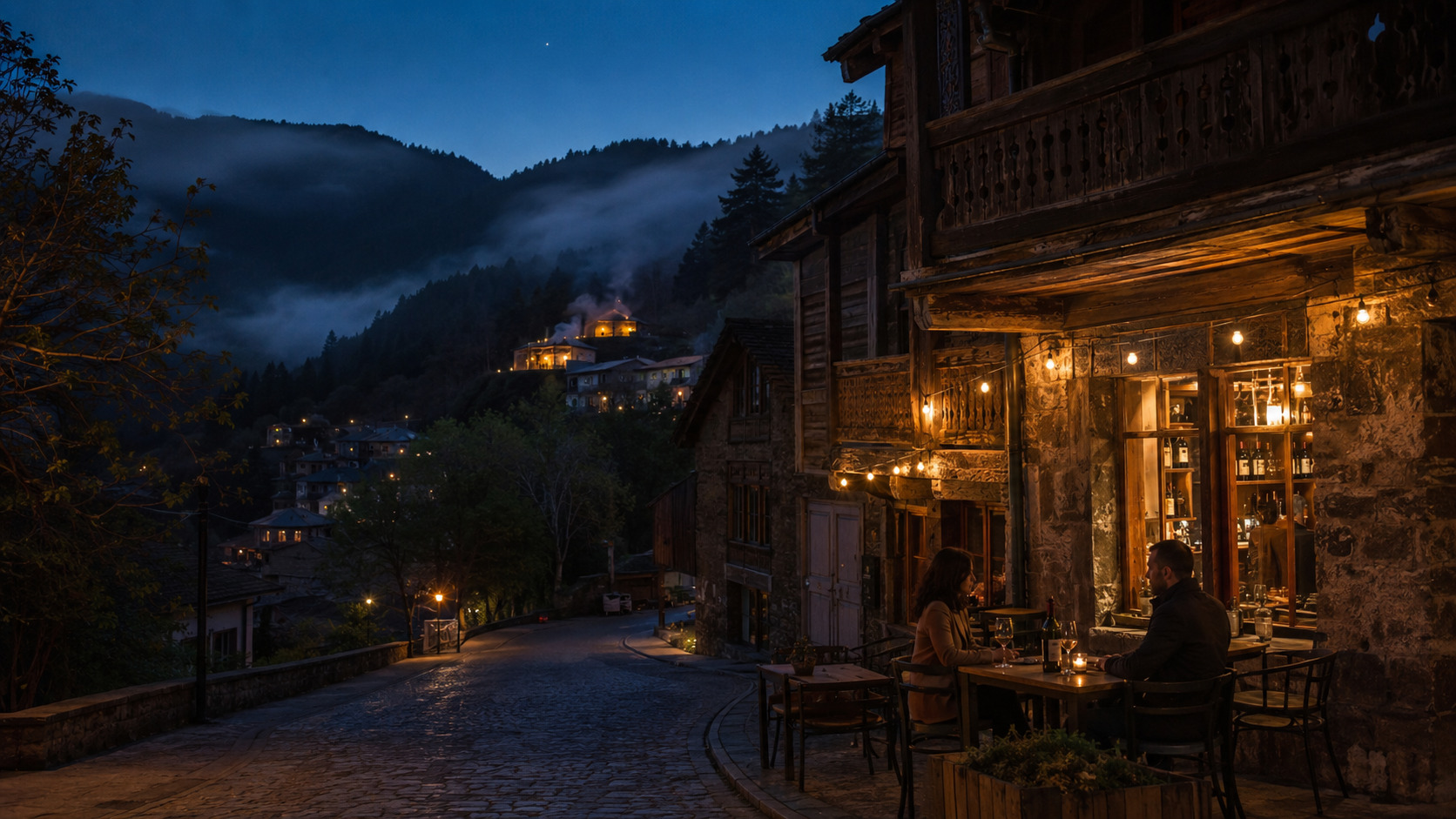
The Kliver Wine Place is one of the most natural places to continue an evening after dinner. Come for Armenian and international wine by the glass, share cheese or snacks, and check the schedule before you go: tastings, winemaker evenings and live music regularly turn a quiet drink into a proper plan.

For something more structured, Hovaz Wine Rooms focuses on sparkling wine and tasting experiences, while Dilijani Tun offers bookable tastings of wine, sparkling wine, fruit vodka and brandy. These are best reserved in advance – Dilijan’s good evenings are often intimate precisely because they are not built for crowds.

For dinner that does not end at nine

Red Forest Restobar is an important new reason not to rush back to your hotel. Open until 2 AM, it fills the gap left by restaurants that close after the standard dinner service. It is the kind of place to choose when you want the table, conversation and drinks to last longer than the guidebook allows.

Cabinet is a more polished option for an earlier, food-led evening: contemporary takes on Armenian ingredients in a restored historic building. Haykanoush, inside the Tufenkian Old Dilijan complex, works well for Western Armenian dishes and Tavush specialities before continuing the night with chess, backgammon or another glass nearby.

For the latest night in town

If the evening has gained momentum, go to Bar No. 1. It can stay open until 4 AM when there are guests in the venue – a rare detail in a town where most places wind down much earlier.

That does not make Dilijan a party capital, and it should not try to be one. But it does mean you are no longer forced to end the night at 11 PM because there is nowhere left to sit.

For live music and cultural evenings

We have already mentioned The Kliver wine place for such a way, so if you are interested in music jams, concerts, film or gastronomical evenings, you can check their social media accounts for schedule. DiliJazz Hotel & Restaurant builds its programme around jazz evenings and changing performers. It is outside the compact centre, on the Haghartsin road, so treat it as a destination rather than a spontaneous stop.

Also keep an eye on programmes at RestArt Boutique Hotel, the Eduard Mirzoyan House of Composers and other local venues. Dilijan does not run cultural events every night, but a jazz set, chamber concert, exhibition or special dinner can be the best reason to stay for a second night. Check the calendar before booking your trip – one good event changes the whole rhythm of a weekend.

For a slow hotel night: spa, sauna, games

When the weather turns cold or wet, the strongest argument for staying overnight may be your hotel.

At DiliJazz, the heated indoor pool, jacuzzi and sauna are open into the evening, while the wood-fired forest sauna and heated outdoor barrel can be booked in advance. Dili Town Resort & Spa offers massage and sauna treatments, and Dilijan Resort & Spa combines its pool and sauna with billiards.

For a more low-key version of nightlife, several hotels also offer film nights, live music, fireplaces and games rooms. In Dilijan, a sauna followed by backgammon and Armenian wine is not a backup plan. It is a very convincing evening.

The reason to stay more nights

Do not try to fit everything into one night. On the first evening, choose a long dinner and wine. On the second, book a tasting. On the third, a spa session or a concert – and keep Bar No. 1 or Red Forest in reserve if you are not ready to call it a night.

Dilijan after dark is not loud. It is warmer, smaller and more personal. And once you know where to go, leaving after one night starts to feel like the real tourist mistake.

Beyond Sharambeyan: the streets that show you another Dilijan

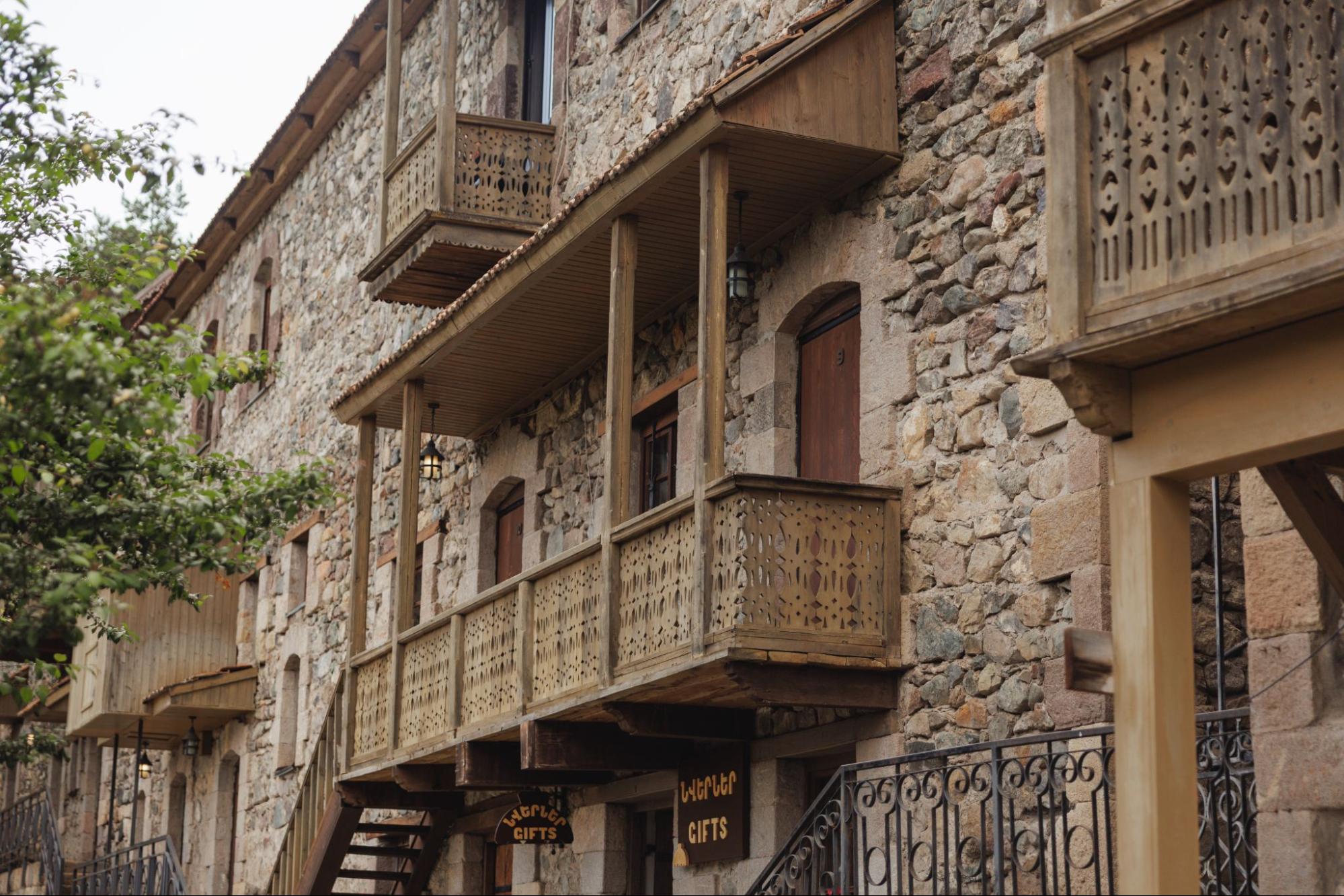
Most visitors to Dilijan walk the same street. It is easy to see why. Sharambeyan Street offers wooden balconies, stone walls, craft workshops and restaurant terraces – a compact, photogenic version of “old Dilijan”. The historical district preserves the town’s 19th-century architectural character, while its modern restoration began in 2004 under Tufenkian Heritage.

Sharambeyan is worth seeing. But if you stop there and leave with the impression that you have seen Dilijan, sorry to say – you haven’t.

Beyond it, wooden houses survive on residential streets, Molokan history hides in Papanino, Soviet modernism reshapes the centre, and an enormous former factory recalls the town’s industrial past. Workshops occupy old buildings, cafés face the lake, and the mountains keep appearing between rooftops.

So finish your coffee on Sharambeyan. Then turn off the postcard street and keep walking.

Myasnikyan Street: where the tourist town becomes a real one

Myasnikyan is a good place to begin because it does not immediately look like an attraction.

Cars pass, people run errands, cafés stand beside everyday businesses, and then an old wooden balcony appears above you. Traditional architecture survives here as part of the living town, not as one carefully restored historical set.

Examples of old Dilijan houses can still be found on Myasnikyan, Kalinin and Lermontov streets. Look for red-tiled roofs, open verandas, slender wooden columns and carved details – an unusually timber-rich architectural language for a country better known for stone.

At No. 28, the Dilijan Museum of Regional Studies and Art Gallery brings together archaeology, ethnography, painting and applied art. Its collection includes more than a thousand archaeological objects, according to the official Armenian museum platform.

Nearby, Buduart connects this heritage with contemporary craft. Artists Arman Badeyan and Margarita Malkhasyan established their studio in a 19th-century house and work with painting, textiles, linocut and copper jewellery. Visitors can also join workshops, including jewellery-making experiences.

For lunch, Tava and Kchuch are both nearby. For photographs, do not search for one perfect facade. Myasnikyan works better as a sequence: a carved window, an old gate, laundry behind a veranda and forest appearing between houses.

Kalinin Street and Papanino: Dilijan before it became one town

Continue away from the historic centre and another layer appears.

Before becoming part of Dilijan, Papanino developed from a 19th-century Russian religious settlement. Local historical sources trace the establishment of Papanino and nearby Golovino to the 1840s. The area’s Molokan history still survives in its domestic architecture.

This changes the way you see the neighbourhood. Its wooden houses are not simply fragments of “Old Dilijan” scattered beyond Sharambeyan. They belong to a more complex story of settlement, migration and different communities living beside one another.

Kalinin Street provides a natural route through this part of town. Restored houses alternate with newer buildings and older structures visibly carrying their age. Papanino House, with its wooden balconies, restaurants and bakeries, makes an easy place to pause.

Lermontov Street: look for fragments, not landmarks

Lermontov Street is worth walking precisely because there may be no single landmark somebody will insist you must see.

This street is also locally known as “qarami qucha”. Some houses have been restored, others are deteriorating. That unevenness reveals more about the city than another polished historical facade.

Look at the depth of the verandas, the carved timber beneath the roofs and the combination of stone at ground level with wood above it. Then notice how the forest constantly enters the composition.

In Dilijan, streets rarely give you only the street. Houses drop away, roofs overlap, mist settles over the slopes, and an ordinary gap between buildings suddenly becomes a panorama.

You do not always need an observation deck to find a view.

Maksim Gorky Street: coffee, the lake and a changing Dilijan

Around the city park and artificial lake, Dilijan becomes more open and social.

Café #2 is one of the town’s best-known everyday meeting points, attracting families, students, visitors and locals stopping for coffee. The park and lake are less a formal attraction than a piece of daily urban life.

Nearby, Dilijan Space explores the town through exhibitions and cultural programmes focused on its architecture, resort history and industrial past. The Dilijan Development Foundation describes it as a centre for research, permanent and temporary exhibitions.

It is a useful stop after walking through the older neighbourhoods. By now, you have already encountered the questions such projects examine: What should be restored? What can be reused? How can Dilijan develop without becoming a historical theme park?

This area also changes the photographic scale. Instead of close-ups of carved balconies, you can frame the lake, street life and new urban spaces against the forested slopes.

The Soviet centre: from carved wood to modernism

Do not return directly to Sharambeyan. Stay in the centre and look for the Dilijan built during the second half of the 20th century.

In 1958, Dilijan received the status of a resort city of republican importance. Active urban development followed. A new administrative centre brought together a Palace of Culture, government buildings, a communications centre, cinema, library and department store, many designed in the modernist language of the period.

The visual change is abrupt. Timber carvings give way to horizontal lines, large stone volumes and buildings created for collective urban life.

Some no longer serve their original purpose and others need restoration. That uncertainty is what makes them interesting. If Sharambeyan represents the heritage Dilijan has already chosen to preserve, the Soviet centre shows a heritage whose future is still being negotiated.

For photographs, use the contrast: strict modernist geometry against irregular green mountains, weathered stone against mist, and monumental civic buildings inside a town that still feels small.

Shaumyan and the road toward Impulse: industrial Dilijan

For a longer walk, continue along the Myasnikyan–Shaumyan axis. Here the familiar resort town begins to change scale.

« Impulse instrument-making factory opened in 1962. At its height, the complex employed more than 3,700 people and produced communications equipment for the Soviet Union. It stopped operating in 2001.

That number alone changes the image of Dilijan. A factory employing thousands was not a curious structure on the outskirts, it shaped jobs, families, housing and everyday routines. Yet this industrial identity is almost invisible if your visit begins and ends with wooden balconies.

This may be the least postcard-like end to a Dilijan walk, which makes it a very good one.

The best Dilijan walk has no final stop

There is no need to cover every street in one afternoon. Turning this walk into another sightseeing checklist would miss the point.

Start on Sharambeyan because it deserves attention. Then leave it. Follow Myasnikyan until something makes you turn. Take Kalinin farther than planned. Look at the old houses in Papanino, wander up a residential street for the mountain view, stop for coffee near the lake and notice the Soviet buildings before deciding whether they are beautiful.

Dilijan has been several different towns at once: a craft town, a Molokan settlement, a mountain resort, a Soviet cultural centre and an industrial community.

Most visitors come looking for one famous street.

The easiest way to see Dilijan is to walk off it.

Beyond the usual route: 5 places that reveal a different Dilijan

Dilijan is often introduced through the same familiar landmarks: a walk along Old Dilijan (Sharambeyan Street), the forests around Lake Parz, and the medieval monasteries of Haghartsin and Goshavank. They are beautiful places and well worth visiting, especially on a first trip. But they are only one layer of a town whose history stretches far beyond its best-known attractions.

This guide brings together five lesser-known places that offer a more authentic perspective on Dilijan. Some can be explored during a leisurely walk through town, while others require a short hike into Dilijan National Park. Together, they reveal a side of Dilijan that rewards curiosity, slower travel and a willingness to step beyond the usual route.

1. Agasi Khandjian villa – a forgotten modernist gem hidden in Dilijan’s forests

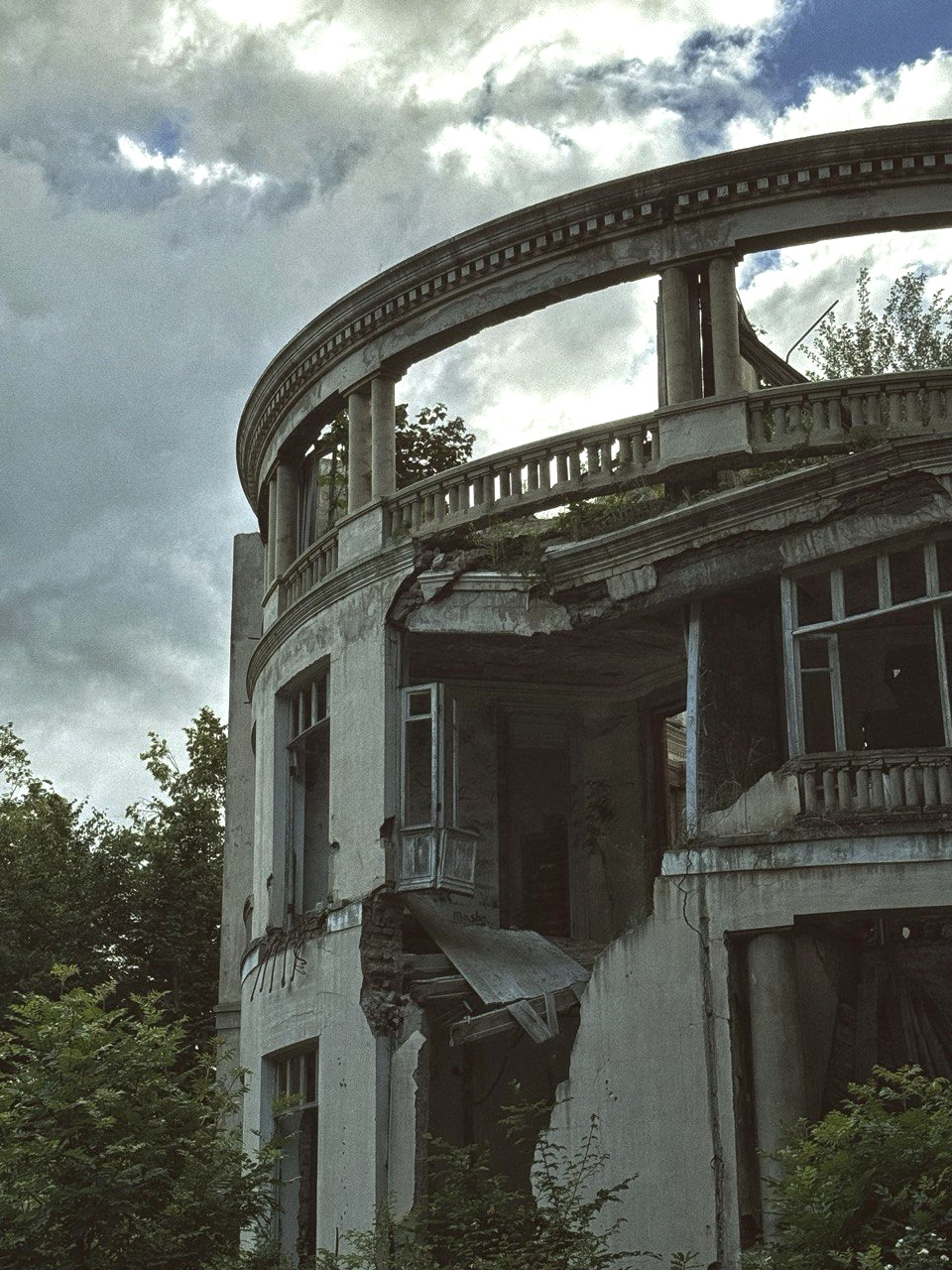
Built in 1936, the villa belonged to Agasi Khandjian, the First Secretary of the Communist Party of Armenia from 1930 to 1936. Like many members of the Soviet elite of that era, Khandjian chose Dilijan as the location for his summer residence. Even at that time, the town was already considered one of Armenia’s most important resort destinations, thanks to its mild climate, dense forests, and fresh mountain air.

The building’s most distinctive feature is its unusual circular design. For the architecture of the 1930s, a cylindrical layout was a rather rare solution. The villa combined functionality, panoramic views of the surrounding landscape, and elements of early Armenian modernism. Its large windows and hillside location created the impression that the building naturally followed the shape of the mountain itself.

The history of the villa is closely connected to Khandjian’s own tragic fate. In the same year the building was completed, the political figure died in Yerevan under circumstances that remain the subject of historical debate to this day. After his death, the villa gradually lost its original purpose and eventually fell into abandonment.

Practical note: The best time to visit is in the morning or evening, when soft light highlights the building’s silhouette and the surrounding forest. The villa is currently abandoned, so it should be approached carefully and respectfully.

2. Shaumyan Street and Impulse: Dilijan’s industrial afterimage

Dilijan is widely known as a resort. Yet in 1962 the Impulse radio-electronics factory opened on its eastern edge. At its height, it employed several thousand people and produced communication-system components. A whole district grew around it: engineers’ housing, a school, cultural and sports facilities. A walk along Shaumyan Street is therefore not urbex, it is a way to see another biography of the town. Dilijan did not only host visitors – it made things, studied and welcomed specialists from across the Soviet Union.

The Himalayan cedar alley is especially striking: unexpectedly lush and almost cinematic against the surrounding forest. It softens the industrial edge of town in a curious, calm way. The former factory matters for its scale and silhouette, not as a site to enter: the grounds are guarded and some structures are unsafe.

Practical note: get off at the Fabrika Impuls bus stop on Shaumyan Street and view the district only from public space. Do not cross fences or enter abandoned buildings.

3. Matosavank: a monastery that does not pretend to be new

Matosavank is a small thirteenth-century monastery in the forest of Dilijan National Park. Unlike carefully restored complexes, nothing here separates history from the woodland: dark stone gathers moss, the vaults hold the half-light, and the ruins of the narthex and book repository do not disguise the passage of time. This is exactly why Matosavank can feel more powerful than a ceremonial monastery. You do not drive up for five minutes; you walk to it.

The trail is often combined with nearby Jukhtak. The two sites have distinct moods: Jukhtak reads as a small, cared-for church, while Matosavank feels like a medieval fragment found in the trees. It is a short route, but not a city stroll. It can be slippery after rain, so download the navigation route in advance.

Practical note: How to visit: the short Matosavank-Jukhtak loop takes roughly 1.5-2 hours. Start from Abovyan Street or walk from the tourist information centre. Wear closed shoes with a grippy sole.

4.The hidden waterfall beyond Haghartsin

Haghartsin has long been a must-see. Yet most visitors turn back at the car park and miss the path that continues into the forest. Beyond the monastery, the Hidden Waterfall Trail leads to a multi-level cascade: wet stones, ferns, a stream and dense beech woodland replace the monastery courtyard. It is a rare chance to extend a popular stop until it feels as though the tourist part of the day has ended and a private one has begun.

The waterfall’s magic lies less in its size than in how completely it is concealed. It appears only at the end of the trail and changes with the seasons. The flow is fuller in spring and after rain, gentler in summer and sometimes modest in a dry spell. The point is not to race to the cascade, but to make a slow transition from architecture to forest.

Practical note: How to visit: the waterfall is about 1.6 km from Haghartsin one way, or 3.2 km return. Allow 1.5-2 hours, bring water and avoid the trail at dusk or after a heavy downpour.

5. Aghavnavank and the yew grove: a different silence in the national park

On the eastern side of Dilijan National Park, near Aghavnavank village, the forest changes character altogether. An easy riverside path leads to the twelfth-thirteenth-century Anapat-Astvatsatsin church, surrounded by relic yew trees. Some are around four hundred years old. Compared with Dilijan’s familiar beech forests, the yew grove feels denser, cooler and almost motionless.

Aghavnavank is commonly translated as the “temple of doves”. Pale church stone, green forest shade and the absence of tourist infrastructure make the place deeply intimate. On the way out of the village, look for the old twelfth-thirteenth-century bridge beside the newer one. This is not an hour-long detour between breakfast and lunch; it is a small journey of its own, which is exactly why it stays quiet.

Practical note: first drive to Aghavnavank village, then follow the signposted riverside trail for around 30 minutes. Allow at least half a day from Dilijan, check the weather and download an offline map.

How to explore Dilijan with care

The places on this list are unlikely to become the postcards that define Dilijan – and perhaps that is exactly their greatest value. They invite you to slow down, wander a little further and notice the quieter stories that give the town its character.

Beyond the famous monasteries and viewpoints, Dilijan is a place of layered histories, living neighbourhoods and forests that still reward curiosity. If you leave with the feeling that you have discovered a version of the town that cannot be found on every itinerary, then you have experienced one of the best things Dilijan has to offer.

Quick choice: which place fits your plan?

Place Best for Time needed
Khandjian Villa Architecture 30 min
Matosavank Hiking + history 2 ժամ
Hidden Waterfall Nature 2 ժամ
Աղավնավանք Slow travel Half day